Logout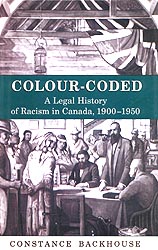
Colour-Coded: A Legal History of Racism in Canada, 1900-1950
 1999
1999 
by Constance Backhouse, Professor of Law, University of Ottawa. Published with the University of Toronto Press, 1999.
Colour-Coded has been translated into French and published in Quebec
as De La Couleur des Lois:
White supremacy had a tenacious hold on the historical roots of the Canadian legal system. Backhouse presents convincing case studies to illustrate how early 20th-century law played a dominant role in creating and preserving racial inequality. The cases focus on Aboriginal, Inuit, Chinese-Canadian and African-Canadian individuals, taking us from the criminal prosecution of traditional Aboriginal dance to the trial of members of the ‘Ku Klux Klan of Kanada!
Related Topics
Contents
Contents
FOREWORD vii
ACKNOWLEDGMENTS ix
1 Introduction 1
2 Race Definition Run Amuck: ‘Slaying the Dragon of Eskimo
Status’ in Re Eskimos, 1939 18
3 ‘Bedecked in Gaudy Feathers’: The Legal Prohibition of
Aboriginal Dance: Wanduta’s Trial, Manitoba, 1903 56
4 ‘They Are a People Unacquainted with Subordination’ –
First Nations’ Sovereignty Claims: Sero v Gault, Ontario, 1921 103
5 ‘Mesalliances’ and the ‘Menace to White Women’s Virtue’:
Yee Clun’s Opposition to the White Women’s Labour Law,
Saskatchewan, 1924 132
6 ‘It Will Be Quite an Object Lesson’: R. v Phillips and the
Ku Klux Klan in Oakville, Ontario, 1930 173
7 ‘Bitterly Disappointed’ at the Spread of ‘Colour-Bar Tactics’:
Viola Desmond’s Challenge to Racial Segregation,
Nova Scotia, 1946 226
8 Conclusion 272
NOTES 283
BIBLIOGRAPHY 433
PICTURE CREDITS 475
INDEX 477
Publications of the Osgoode Society 487
Awards
- Ontario Historical Society's Joseph Brant Award (2002)
Reviews
Colour-Coded convincingly documents the case for the real-life consequences of racialization in Canada. If one of its goals was to obliterate the “stupefying innocence” of Canadians regarding racism in Canada, it has surely succeeded. Beyond that, it provides an invaluable teaching tool for law schools, the Bar and the Bench. Emily F. Carasco, Windsor Yearbook of Access to Justice, Vol 20, 2001, pp. 341-343
Law professor Constance Backhouse has a wonderfully direct way of telling stories and explaining convoluted case law, so I too will be direct. I loved Colour-Coded. Laura Robinson, Globe and Mail, February 12, 2000
Lori Chambers, Acadiensis, vol 41, 2012, pp. 255-256
Stephanie Cole, Law and History Review, Vol 20, 2002, pp. 221-223
Dianne Newell, Canadian Journal of Women and the Law, Vol 14, 2002, pp. 225-228
Adelle Blackett, McGill Law Journal, Vol 46, 2001, pp. 1175-1176
Bryan D. Palmer, Alberta Law Review, Vol 38, 2001, pp. 1080-1084
Melanie R. Durette, Saskatchewan Law Review, Vol 64, 2001, pp. 649-650
Benjamin Berger, Osgoode Hall Law Journal, Vol 38, 2000, pp. 524-529
Franki Elliott, Canadian Law Libraries, Vol 25, 2000, pp. 178-179